

Finding a Citizen Chronometer in Ginza
Every collector has that one watch that refuses to leave his mind. Not the watch everyone else is chasing. Not the latest release, nor the one commanding six-figure auction results. Rather, it is the piece that quietly occupies your thoughts for years, appearing unexpectedly in old catalogues, on obscure Japanese websites, or on the wrist of someone who clearly knows exactly what he is wearing.
For me, that watch was the hand-wound Citizen Chronometer.
I searched for one for years.
Readers of The Watch Brief may remember my rather frantic adventure in Palermo, where I found myself sprinting between cash machines to secure a rare 1930s Minerva Flight Chronograph. This story could hardly be more different. There was no lucky accident here, no chance encounter in a dusty shop window. This was a pursuit that demanded patience rather than impulse—and it finally came to an end in Tokyo.
Finding a Citizen Chronometer is not particularly difficult. Finding one in honest, original condition certainly is. Over six decades, many examples have been polished into softness, refinished, or fitted with replacement dials, hands or crowns. A watch like this deserves better.
An Afternoon in Ginza
Every summer, Tokyo's Ginza district hosts what is arguably my favourite vintage watch event anywhere in the world: the LowBEAT Antique Watch Fair, organised by the team behind LowBEAT magazine, Japan's leading publication dedicated to vintage watches.
Unlike the large international fairs, this one feels unmistakably Japanese. There is no unnecessary spectacle, no celebrity appearances, no marketing theatre—just dozens of respected dealers presenting carefully curated selections of vintage watches, many of which rarely, if ever, leave Japan.
Whenever I happen to be in Tokyo in early August, I make a point of visiting.
Four years ago, my annual pilgrimage finally paid off.
Walking through the aisles that afternoon, I enjoyed the familiar mixture of temptation and restraint. Wonderful King Seikos. Beautiful early Grand Seikos. Exceptional Longines, Universal Genève and Omega chronographs. Every few minutes another watch demanded attention.
After nearly an hour, I had almost convinced myself that this year's visit would end like all the others.
Then, almost hidden among considerably more expensive pieces, I saw it. A Citizen Chronometer.

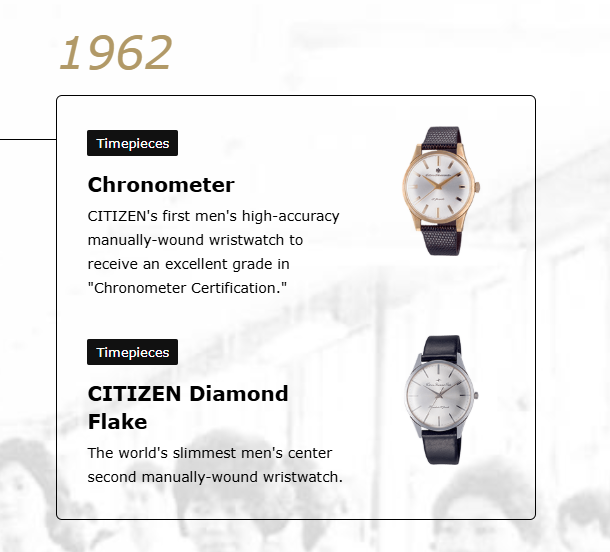
The silver sunburst dial reflected the exhibition hall's lights with a soft metallic glow. The applied indices remained razor-sharp, the dauphine hands untouched, and the small eagle beneath twelve o'clock immediately confirmed that this was no ordinary Citizen.
I asked to examine it, but within seconds I knew that it was as I had always hoped. The dial was original. The case retained its crisp geometry, the facets of those beautifully sculpted lugs still clearly defined. The correct "C"-signed crown was still present. The movement was clean.
Most importantly, it possessed something every experienced collector recognises instantly, yet nobody can properly define: Honesty.
Years of searching had suddenly come to an end.
Citizen Chronometer: Japan's Forgotten Precision Masterpiece
To understand why the Citizen Chronometer matters, one has to travel back to the early 1960s - the moment Japanese watchmaking stopped trying to imitate Switzerland and instead began competing with it on equal terms.
In 1960, Seiko had thrown down the gauntlet with the first Grand Seiko, a watch built to chronometer standards and aimed directly at the finest Swiss manufacturers. Citizen had little choice but to respond.
Its answer arrived in November 1962.

The company called it, with remarkable confidence and disarming simplicity: Chronometer.
But what makes the Citizen Chronometer particularly fascinating is the path Citizen chose to reach that goal. Where Seiko based the first Grand Seiko on an evolution of its existing Crown movement, Citizen took the far more ambitious route. Rather than refining an existing calibre, it developed an entirely new movement specifically for this one watch: the hand-wound Calibre 0400/0401, fitted with 31 jewels.
The engineers made two bold decisions.
First, they equipped the movement with an unusually large balance wheel to maximise stability and precision. Second, they fitted an oversized mainspring barrel capable of delivering approximately 53 hours of power reserve—an exceptional figure for the early 1960s.
Accommodating both components required a highly unconventional gear train layout, one that immediately catches the eye when viewing the movement and remains one of its defining characteristics among Japanese collectors today. Nothing about this calibre was borrowed. Everything was purpose-built for precision.
The movement reflected a much broader ambition. During the 1960s, Citizen invested heavily in observatory chronometry trials, particularly at Neuchâtel, where Japanese manufacturers were steadily proving that Switzerland no longer held a monopoly on mechanical precision. The Chronometer emerged directly from that engineering culture. It was not conceived to imitate Swiss chronometers; it was built to rival them.
The testing regime matched those ambitions.
Citizen regulated the watch to a mean daily rate of −1 to +10 seconds per day, precisely the standard applied by the official Swiss chronometer testing bureaux between 1961 and 1973. Surviving rating certificates reveal individual watches performing comfortably within those tolerances, some recording average daily deviations of less than a single second.
Period sources even suggest that every movement was assembled from start to finish by a single watchmaker, which was an almost artisanal approach at a time when much of the industry was already embracing industrial mass production.
Profitability was clearly not the objective. Making a statement was. The Chronometer was also the first Citizen to carry the now-famous eagle emblem, a symbol the company continues to reserve for its highest-end mechanical watches more than sixty years later.
Every eagle appearing on a modern Citizen Chronomaster traces its lineage back to this watch.
Production lasted only around four years before quietly disappearing. Ironically, the Chronometer's greatest strength also sealed its fate. It was expensive to manufacture, labour-intensive to regulate and perhaps simply too ambitious for a rapidly changing industry. As automatic movements became increasingly popular and quartz technology approached the horizon, Citizen discontinued one of the finest hand-wound watches it had ever built.
Understated Excellence

One of the things I admire most about the Citizen Chronometer is its remarkable restraint.
There is no attempt to impress through unnecessary complications or extravagant design.
Instead, every detail serves a purpose. The beautifully balanced silver sunburst dial. The perfectly proportioned dauphine hands. The sharply faceted applied markers. The discreet eagle beneath twelve o'clock.
Even the gold medallion on the case back quietly reinforces the watch's status without ever becoming ostentatious.
There is another characteristic that deserves special mention because it addresses perhaps the most common criticism Western collectors have of vintage Japanese watches: size.
Anyone who has searched for early Grand Seikos, King Seikos or vintage Citizens knows the familiar disappointment of discovering an extraordinary dial online, only to realise the watch measures 34 or 35 millimetres.
The Citizen Chronometer is different.
At approximately 37 mm, it was genuinely large for its time. More importantly, Citizen understood proportions. The broad dial opening, long faceted lugs and slim bezel create a visual presence that allows the watch to wear more like a modern 39 mm piece while preserving every bit of its vintage elegance.
For collectors who admire Japanese vintage but struggle with smaller cases, this may well be the perfect compromise.
Even today, more than sixty years later, winding the movement each morning provides that wonderfully reassuring tactile sensation that only an exceptionally well-made hand-wound calibre can offer.
And thanks to that oversized mainspring barrel, it will still be happily ticking away two days later.
Why Is The Citizen Chronometer So Expensive?
For decades, the Citizen Chronometer remained one of vintage watch collecting's best-kept secrets. Outside Japan, few collectors even knew it existed. Inside Japan, it spent years living in the long shadow cast by the mythology surrounding the first Grand Seiko.That has changed dramatically over the last decade.
As collectors began looking beyond the obvious names, attention naturally shifted towards watches combining genuine historical significance, technical sophistication and true rarity.
The Citizen Chronometer fulfils every one of those criteria, especially since production was so brief, and many existing models have been polished beyond recovery. Most were produced in gold-filled cases, while stainless-steel examples remain considerably scarcer. Truly original dials have become increasingly difficult to find.

When I first started searching, excellent examples could still be purchased for prices that today seem almost unbelievable. Year after year I watched asking prices creep upwards, then rise sharply, before accelerating as more international collectors discovered what Japanese enthusiasts had quietly appreciated for decades.
Today, an outstanding example commands several times what it did only a few years ago.
Personally, I suspect the market is still catching up with the watch's true historical significance.
Unlike many fashionable vintage pieces whose values are driven primarily by hype, the Citizen Chronometer's growing reputation rests on something considerably more durable:
Genuine technical excellence.
More Than Another Vintage Watch
Several years on, the watch has found its permanent place in my collection—and, more recently, on a green stingray strap. The textured ray skin complements the quiet sophistication of the silver dial remarkably well. It is an unusual pairing, but somehow it feels entirely appropriate for a watch that has always followed its own path.
Whenever I wear it, I remember not only the years spent searching but also that afternoon in Ginza. Thousands of watches surrounded me that day. Some were objectively rarer. Many were considerably more expensive. Yet it was this quietly confident Citizen that came home with me. Looking back, I realise I never really chose this watch. It chose the pace.
It taught me that not every great acquisition comes from acting quickly. Sometimes the finest watches reward the collector who is willing to wait—sometimes for years.
And when that moment finally arrives, somewhere among hundreds of watches on a crowded exhibition floor in Ginza, you simply know.
The search is over.

If you happen to be in Tokyo in early August, make time for the LowBEAT Antique Watch Fair. If you go: the 7th LowBEAT Antique Watch Fair takes place on 8–9 August 2026 at Ginza Phoenix Hall (2F, Kami Pulp Kaikan Building) in Tokyo. Advance tickets are available through the LowBEAT Marketplace. If you are anywhere near Tokyo that weekend, it is — in this collector's opinion — the finest concentration of honest vintage watches you will find under one roof. Just don't be surprised if you leave with more than you planned.
Thank you for reading this guest review from esteemed vintage watch collector Domitian, whose collection spans everything from a modern Speedmaster to a vintage Minerva chronograph with less than a hundred pieces still in working condition.


Great article. Hunt for the vintage ones is probably the best part of this hobby.